Anatomy of a flow cell: what is actually inside a Nanopore run
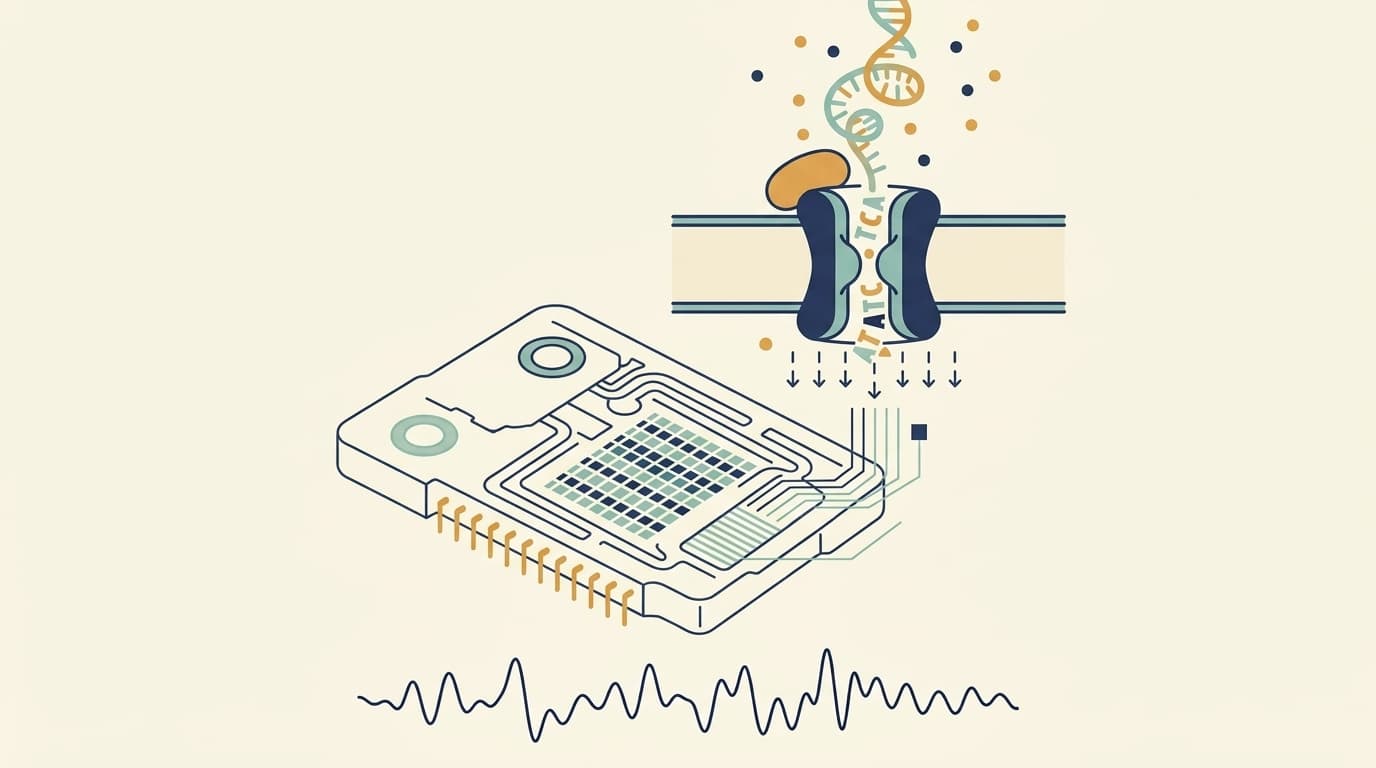
A flow cell looks like a small plastic cartridge, about the size of a stapler. Students handling one for the first time usually treat it with the caution you would give any expensive consumable, without quite knowing what is happening inside it once the run starts. This note is a blueprint of sorts: what you can see from outside, what sits underneath, and how a single sensor turns a molecule of DNA into a sequence of letters.
What a flow cell actually is
A flow cell is the consumable part of the nanopore sequencing workflow. It is where the chemistry and the sensors live, and it connects electronically to the sequencing device so the signal it produces can be read and turned into base calls in real time.
What you see from outside
On a MinION or GridION flow cell, two ports give access to the sensor array underneath: the priming port, used to prepare the flow cell before loading, and the SpotON port, positioned directly over the array, where the prepared sequencing library is dropped in. The SpotON port sits over a small valve, which is what keeps the sample sealed in once it has been loaded. A PromethION flow cell simplifies this to a single inlet port used for both steps. Both designs also have a waste channel and waste port, draining into an internal waste reservoir where excess buffer collects during preparation and washing.
Two more details are easy to miss but useful to know. Each flow cell carries its own printed flow cell ID, a short alphanumeric code used to register that specific cell when a run starts, and underneath it sits a gold-pinned connector, the physical link that plugs into the sequencing device and carries both power and the raw electrical signal out to MinKNOW.
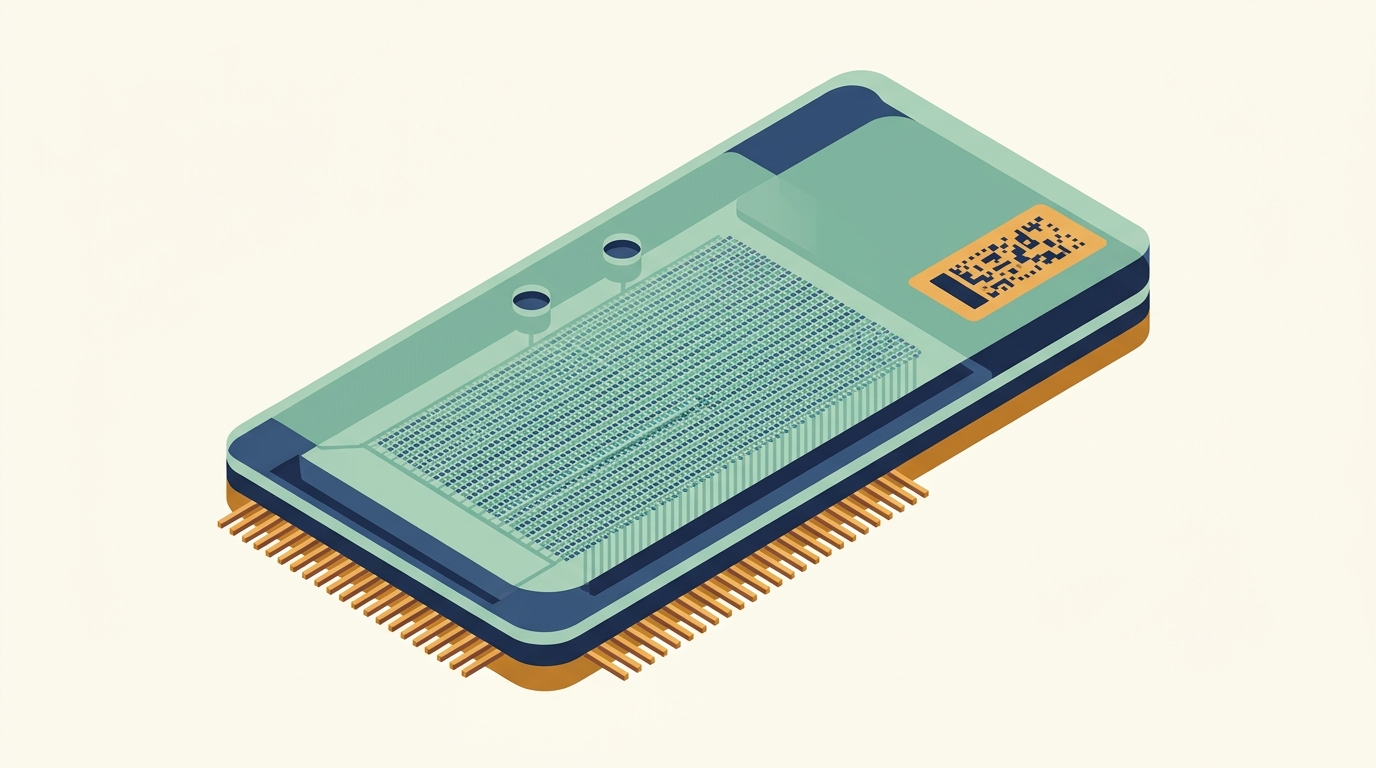
A new flow cell arrives filled with storage buffer, which gives the array a yellow-green colour through the covercite. Before sequencing, this buffer is flushed out and replaced with a priming mix, in two rounds, with a five-minute wait between each. A light shield sits on top during the run. It is a simple piece of plastic, but it matters: protecting the flow cell from light extends pore lifetime and improves output.
What is underneath the ports
Beneath the surface sits the array: a dense grid of microfluidic channels, each one built around a synthetic membrane with a single protein nanopore embedded in it. Each channel is wired to its own electrode, connected in turn to a sensor chip that measures the electrical current flowing through that one pore. This is the part of the flow cell doing the actual sequencing; everything else, the ports, the buffer, the waste channel, exists to get a clean sample to this array and keep it in working condition.
Physically, the sensor chip is a small circuit board, not much bigger than a fingernail, sitting inside the flow cell's outer casing. It is sandwiched between a gasket, which seals the microfluidic channels against it, and a plastic retainer underneath, which holds the whole stack in place and in contact with the connector. Pulling a flow cell apart, as Oxford Nanopore's own diagrams do, makes the point clearly: almost everything about the device exists to protect and feed that one small chip.
How a single sensor reads DNA
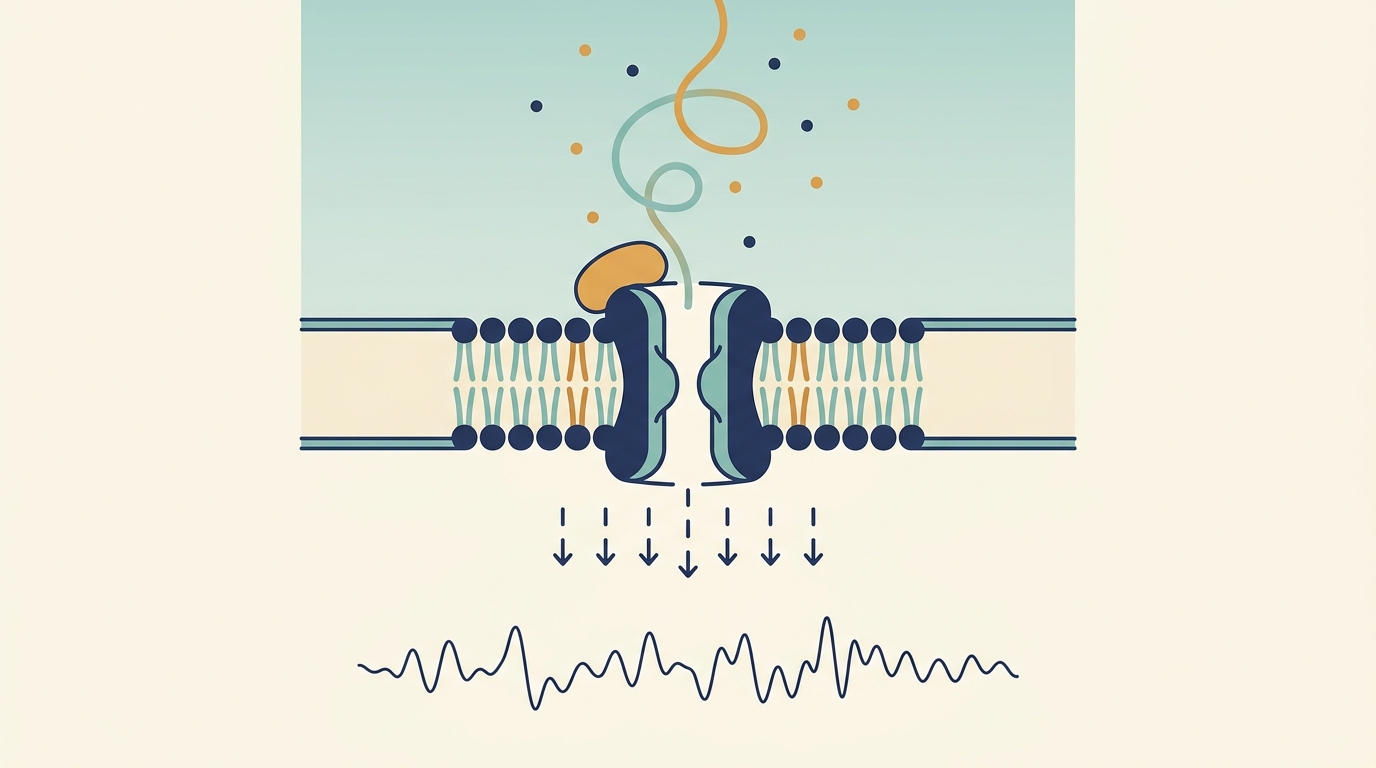
The motor protein is not something the pore picks up along the way. It is pre-loaded onto sequencing adapters during library preparation, attached to the DNA or RNA before the sample ever reaches the flow cellcite. Once the library is loaded, the motor protein associates with a nanopore and controls the speed at which the molecule passes through it, base by base rather than all at once. A voltage applied across the membrane both draws the strand through and drives a steady ionic current through the open channel; for double-stranded DNA, the motor protein separates the two strands first, feeding through a single strand, while RNA is read directly without that step. As each base passes through the pore, it disrupts this current in a characteristic way, and basecalling software decodes that disruption into a sequence of letters, in real time, while the run is still going.
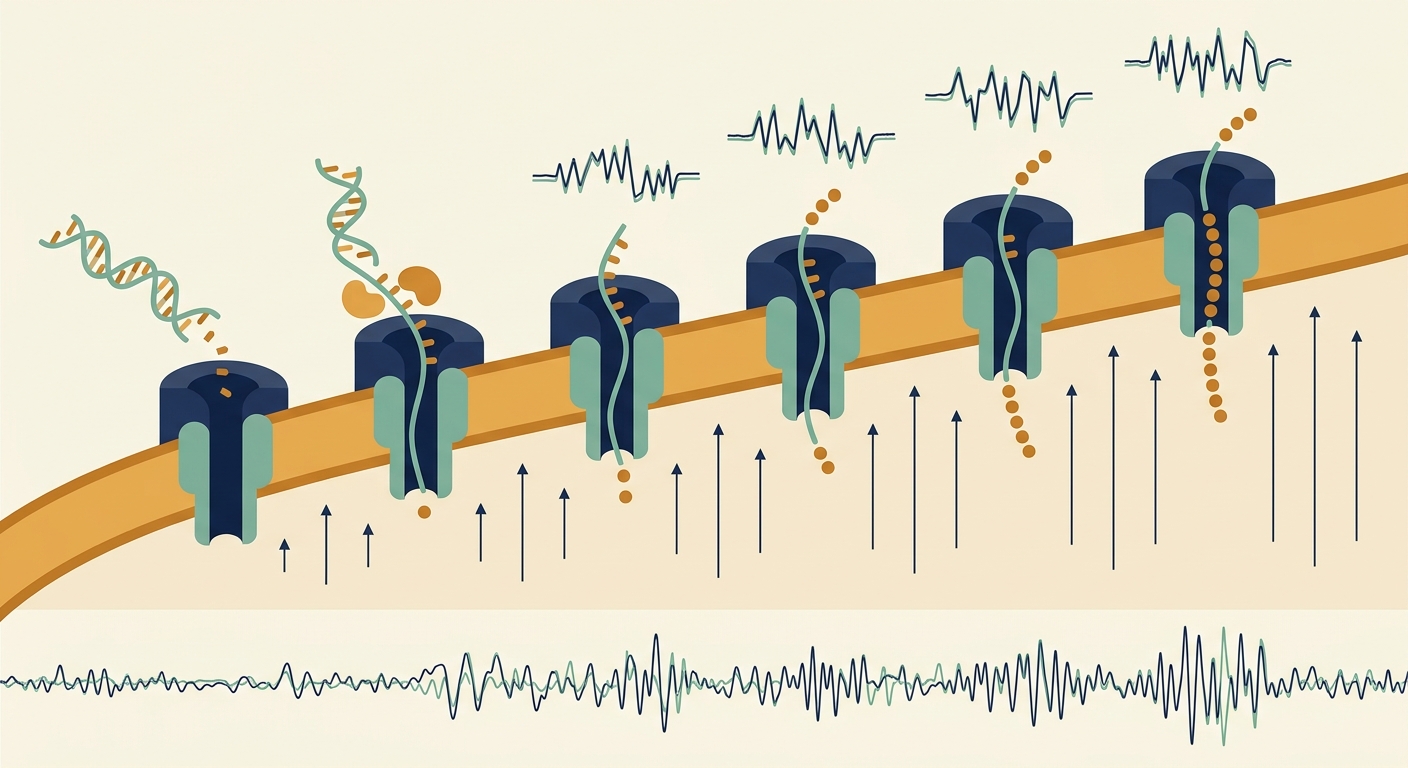
Seen as a sequence rather than a single frame, the process is easier to place in time: the strand approaches free in solution, the motor protein catches it and begins separating the two DNA strands, and as more of the single strand threads through the pore the current trace above it picks up more structure, because there is more sequence, and more motor-controlled movement, for it to reflect.
How thousands of sensors work together
A flow cell is not one sensor but an array of them, and that is where the scale of a sequencing run comes from. A MinION or GridION flow cell carries up to 512 sequencing channels, while a PromethION flow cell carries up to 2,675cite.
It is worth being precise about what "channel" means here. The number of active sequencing channels is not the same as the total number of physical pores sitting in the membrane. Many more pores are present than are ever active as channels at once; at the start of a run, the device runs a pore scan to identify which channels are in good working order, and that subset, not a fixed number printed on the box, is what actually sequences. This is also why the product listings say "up to" a given figure rather than a flat count.
Why a flow cell stops working well
Pores fail for a few distinct reasons, and it is useful to keep them separate because each points to a different fix. A pore can simply become blocked, usually by residual DNA or library material sitting in the channel. A membrane can be damaged, most often by an air bubble introduced during loading or washing; Oxford Nanopore's own protocol is explicit that air crossing the sensor array can irreversibly damage porescite, which is why every loading step in the official protocol is built around never letting the buffer level drop below the array. And simply running a flow cell for a long time degrades conditions generally, independent of any single mistake.
What washing actually does, and does not do
A Flow Cell Wash Kit lets the same flow cell run more than one library. The wash mix contains DNase I, which digests the DNA library currently sitting on the array, clearing blocked channels so they become available again. What it does not do is repair a pore whose membrane has actually been damaged. A wash recovers channels that were blocked; it cannot bring back channels that were destroyed. In practice, a flow cell typically tolerates three to six wash-and-reuse cycles before the usable channel count falls too far to be worth another run, though this varies with how the flow cell was treated along the way. After a wash, or before storing a flow cell at 2 to 8°C for later use, a flow cell check reports the number of available pores, which is the only reliable way to know the real state of the array rather than assuming it.
MinION and PromethION, side by side
The two formats share the same underlying principle, but differ in how they are built for scale. A MinION or GridION flow cell runs individually and tops out at 512 channels; GridION can run up to five flow cells at once. A PromethION flow cell carries up to 2,675 channels, and the device itself scales further still, from two flow cells on a PromethION 2 Integrated up to 24 on a PromethION 24. The sequencing chemistry does not change between them; what changes is how many of these arrays you can run in parallel.
Three layers to keep separate
The practical reason to understand this architecture, rather than just following a loading protocol, is diagnostic. A flow cell's behaviour is the product of three layers that can each fail independently: the microfluidics that move buffer and sample across the array, the biological sensors, the membrane and the pores themselves, and the electronics that measure and digitise the current. A poor yield caused by a fluidics problem, a damaged membrane, or a basecalling issue downstream can look similar from the outside, in a lower-than-expected read count, but the fix is different in each case. Knowing which layer you are looking at is most of the diagnosis.
It is also, in a small way, a direct descendant of the chemistry covered in an earlier Note on the origins of sequencing: the problem of reading a DNA sequence one base at a time has not gone away, only the instrument reading it has changed almost beyond recognition.
Sources: Oxford Nanopore Technologies' own product and protocol documentation, current as of October 2026: the Flow Cell Wash Kit (EXP-WSH004) protocol, the flow cells product listing, the "Loading Oxford Nanopore flow cells" blog post (25 February 2026) and its labelled diagrams, and the platform technology overview. Figures such as channel counts and reuse cycles are Oxford Nanopore's own stated numbers and may change with future flow cell chemistries.
Last updated: 16 October 2026